
How Chinese Medical Schools Are Opening Their Doors to International Students in 2026 The landscape for international students seeking to study medicine in Ch……
How Chinese Medical Schools Are Opening Their Doors to International Students in 2026
The landscape for international students seeking to study medicine in China continues to evolve, shaped by shifting government directives, evolving visa frameworks, and maturing accreditation standards. For prospective students from Bangladesh, Pakistan, Nigeria, Ghana, and the Gulf region, staying informed about the latest policy developments is essential before committing to an MBBS in China or any other medical program offered by Chinese medical schools. Recent shifts across the Ministry of Education, the National Medical Commission, and the China Scholarship Council signal both new opportunities and new requirements that every applicant should understand.
One of the most significant recent developments concerns the tightening of Chinese medical degree recognition abroad. The National Medical Commission, working closely with the World Health Organization, has strengthened quality assurance for programs taught to international students. The WHO listing of a program, once a simple checkbox, now carries heavier weight in the eyes of foreign medical councils. Students should verify that their target Chinese medical schools appear on the WHO directory and that the English-medium MBBS in China curriculum has been approved specifically for foreign enrolment. Many programs now carry dual MOE accreditation status, confirming that the degree is both nationally recognized by China and internationally valid for graduation abroad.
The China Scholarship Council has also introduced notable adjustments to its 2026 annual cycle. The CSC scholarship continues to cover full tuition, accommodation, and a monthly living stipend for selected undergraduate medical candidates, but competition for MBBS places has intensified year over year. Applicants from Southeast Asia and Africa are now advised to submit applications at least one full semester ahead of the intended intake and to secure an official pre-admission notice from the host university before submitting the CSC portal application. The Chinese Government Scholarship remains the single most affordable route for international students to study medicine in China, but early preparation and strong academic credentials are increasingly the deciding factors.
On the regulatory side, the National Immigration Administration has introduced streamlined procedures for medical students on X1 long-term student visas. Students enrolled in six-year MBBS programs at MOE-accredited institutions are eligible to complete their full degree stay on a single visa registration, with renewal handled through local public security bureaus at the university city level. This simplification removes the previous requirement for mid-degree visa reapplication that caused administrative delays for students at institutions in cities such as Wuhan, Nanjing, Guangzhou, and Harbin. The change is particularly beneficial for students attending Chinese medical schools in inland cities where local immigration offices may have limited foreign-language capacity.
Another important policy shift concerns the medical license exam in China, officially designated as the National Medical Licensing Examination. The National Medical Commission has published updated eligibility criteria confirming that international students who hold a complete English-medium MBBS in China degree from a recognized Chinese university are eligible to sit for the Chinese medical licensing examination in English. For students planning to practice within China after graduation, this opens a concrete career pathway. For students returning home, the Chinese degree combined with passing an equivalent medical license exam in their home country, such as the Bangladesh Medical and Dental Council examination or the Nigeria Medical Council Prometric examination, provides a recognized route to clinical practice.
The Ministry of Education has also released updated guidelines regarding the recognition of Chinese medical degrees for graduates who return home after graduation. Several bilateral agreements between China and countries including Pakistan, Afghanistan, and Cambodia now provide explicit mutual recognition pathways, meaning that graduates can obtain domestic licensure more quickly than in the past. However, students from countries without such agreements should consult their national medical council before enrolling to confirm that an MBBS in China meets local registration requirements.
Financial and administrative transparency has also improved across the sector. Chinese medical schools are increasingly required to publish complete fee breakdowns, including tuition, laboratory fees, clinical rotation costs, and housing expenses, in both Chinese and English. This reduces the risk of hidden costs and allows international students to compare programs on a genuine basis. Prospective applicants should verify fee schedules directly from the university international admissions portal and cross-reference them against the published standards on the Ministry of Education website.
For students considering a medical career in China, understanding these policy developments is as important as understanding the curriculum itself. The combination of WHO-listed programs, MOE accreditation, CSC scholarship funding, and eligibility to sit for the medical license exam makes study medicine in China a credible and increasingly well-regulated choice for international students from every region.
Contact our study advisors for a personalized consultation on visa procedures, scholarship timelines, and program eligibility tailored to your nationality and academic background.
微信:yixueliuxue888

2026 全球临床医学升学与海外执业全景直通车
胚胎学博士石磊院长领航 · 30国官方医学院库 · 三维中留服认证风控 · 国际执业考培(USMLE/PLAB/LMCHK)闭环护航
《贝贝壳全球医学留学白皮书 · 学科专章(2026 版)》
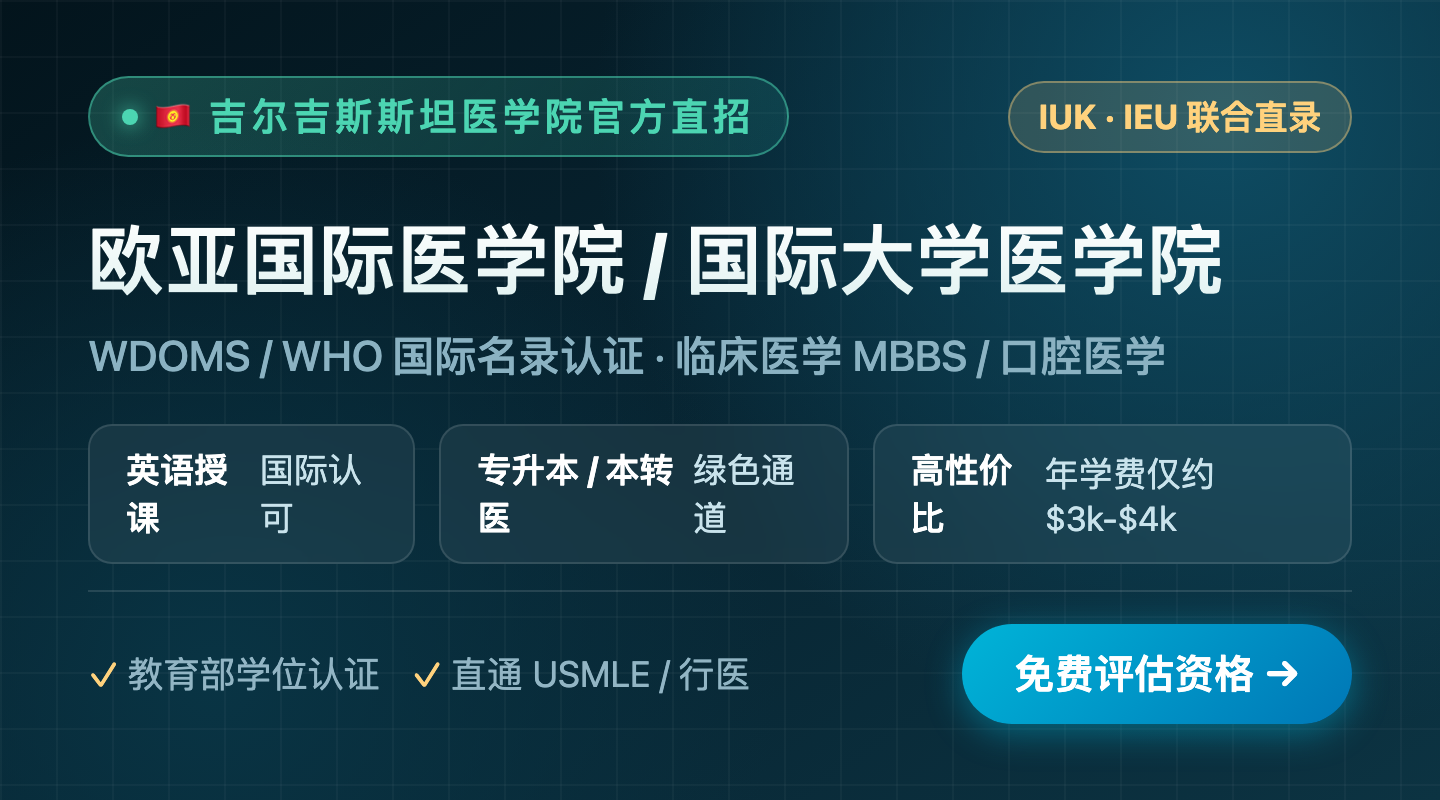
中亚五年制临床医学路径全拆解:IUK 与 IEU 院校与学制、35.5–46.7 万元全周期预算账本、留服认证材料清单与《医师法》第九条回国报考衔接。
 支付宝扫一扫